Noise fills the room as students enter Instructor Michelle Stoel’s Humanities class. The desks are arranged in a loop, so everyone can view the new decoration in the middle of the room: an impressive model of Shakespeare’s Globe Theater. No one knows what it is yet, but the bustle dies down as the bell rings and Stoel explains that the class will start reading Hamlet and that a West Ottawa High School student made the model decades ago.
Teachers often use old projects from students as examples and decorations. Stoel said, “I’m running out of space now, so it’s harder for me to keep new projects, but I would say [I keep] maybe 2 to 3 per year.” English instructor Josie Cheney shared this sentiment. She said, “For a really long time, I kept so many and then last year, I had run out of space, but I kept a few that I thought were really good representations of student art connected with literature.”
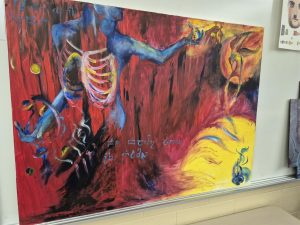
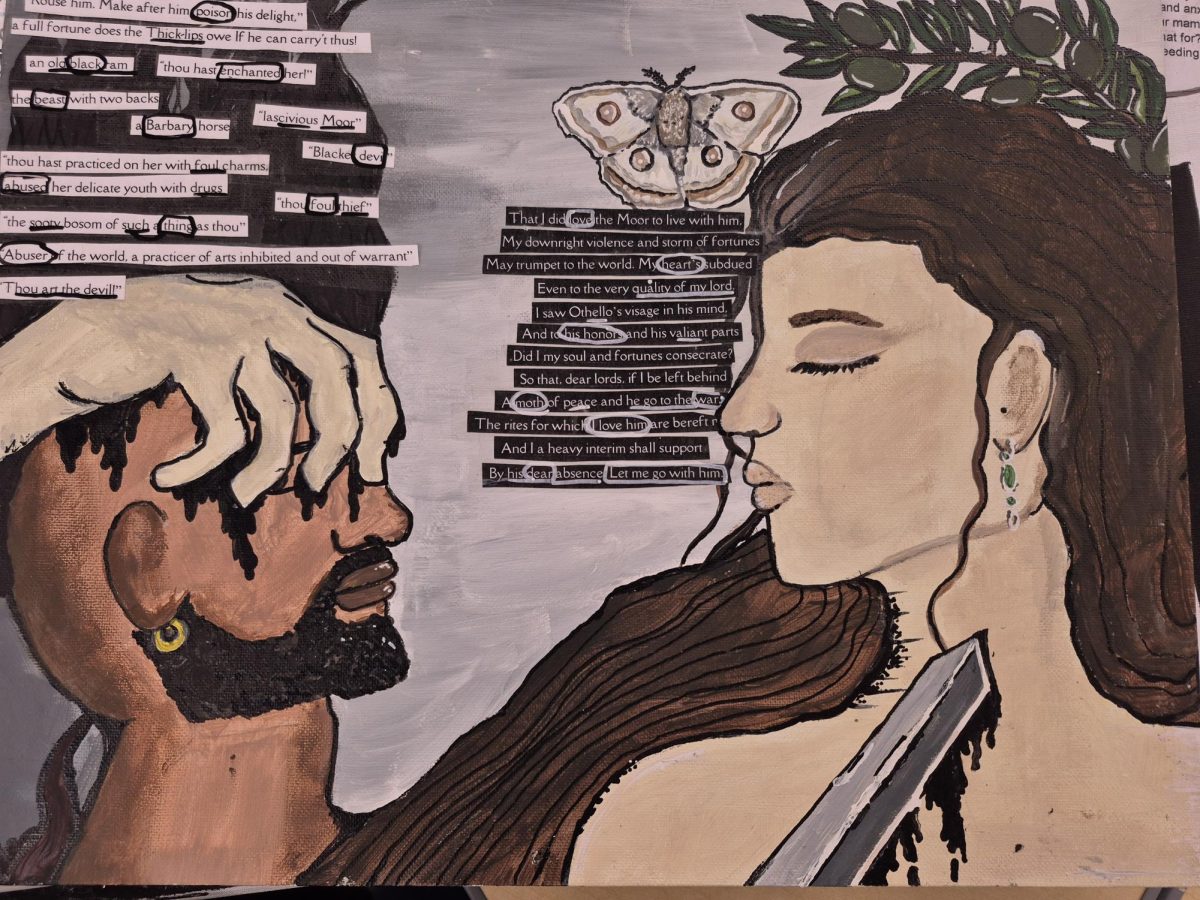
Students benefit from the process of creating art projects in the classroom. Tangible projects help students develop their talents and explore subjects in a different way from more abstract assignments, like essays or worksheets. Cheney said, “I personally notice that when students are given an opportunity to be creative with their hands, it definitely taps into a different layer of thinking.” Projects can even be a part of how students develop skills that will help them in a future career. For example, Stoel said that the student who made the painting pictured here now “travels the world and restores artwork.”
Stoel and Cheney both display old student art around their room as decoration and examples. Stoel said, “I am not an artistic person, but it’s a talent that I wish I had, and because of that I make my room beautiful with students’ talents.” Cheney has examples of an AP Lit project where students make an artistic representation of a book using a certain literary lens that they can choose. When she used to teach AP Lit, she used the projects to help her explain the assignment. For example, the model of a book represents Fahrenheit 451 with a burned dictionary, and the collage is about the play Fences viewed through a psychological lens.
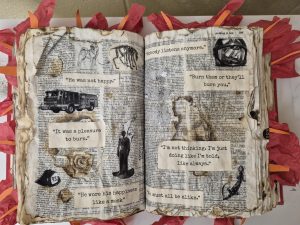
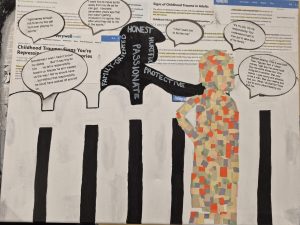
Cheney sees how these examples benefit current students, saying, “if I think of an idea, I can picture it in my head really well, but if it’s somebody else’s idea, sometimes I need to see very different examples to help me.” Old projects from previous students often help students to be successful in their own work.
Old projects can even become a part of WO history. This is the case for the Globe Theater model. Stoel said that it “has been in West Ottawa High School for over 30 years, because it was here before I even started teaching, and it has gone from classroom to classroom.” Even when a student leaves West Ottawa, their art can continue their legacy at WO, with previous projects serving as examples. Stoel hopes that keeping some projects “makes students first feel a warmth and that I value their talents and creations, but also maybe serves as a model for what they might create.”