
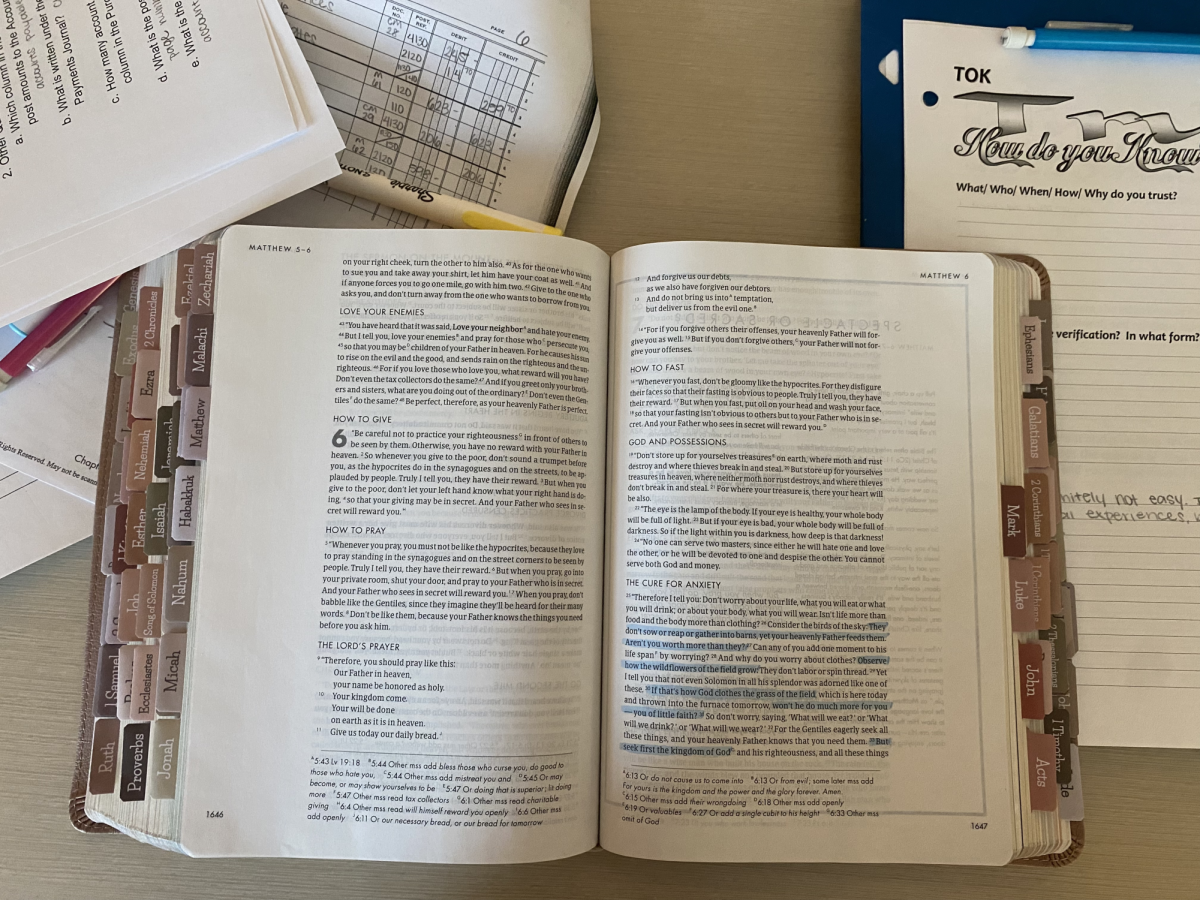
The clock hit 11:47 p.m., and I was rewriting the same words on a paper that my teacher would read once and never think about again. I knew the content mattered more than my handwriting and it didn’t need to be perfect, but I couldn’t leave it alone.
The way things looked mattered more than I wanted to admit. My desk, my notes, my assignments. Everything had to be in order, everything had to look just right. Not because someone else was going to see it, but because I couldn’t let it be any way else. I would fix things that didn’t need fixing, straighten things that were already straight, start over when something felt even slightly off. It was never really about the thing itself. It was about the feeling I got when things weren’t perfect. I couldn’t ever move on from that feeling. Things were never just right.
Having everything perfect doesn’t sound terrible. A consistently clean room, an organized desk, no clutter; for most people, that’s aspirational. But when you’re living in a constant cycle of pressure to meet a standard that is barely reachable, it becomes exhausting.
I grew up being told I was bright, talented, smart, mature, organized, advanced; truly Type A. I loved hearing it, especially when my teachers would say it all to my parents during conferences. In third grade, a classmate called me “little miss perfect,” and while I promised it annoyed me, I remember feeling a strange sense of satisfaction.
Over time, it started to feel less like I was perfect and more like there wasn’t a choice to be. It felt like pressure I couldn’t escape. It showed up in small things at first. Things that didn’t seem important enough to matter.
A stack of papers on my desk had to be straightened before I could focus. A sentence I had already written would feel wrong, even if I couldn’t explain why. I would erase, rewrite, adjust, and repeat until it felt like I had finally reached something close enough to being just right. It never was. I couldn’t stand the feeling that something was slightly off.
Every day of my junior year, I would get home and instead of homework, I would straighten up my room. I had to make sure my clothes were put away, everything on my desk was where it was supposed to be, and my pillows were in the right spot. I couldn’t open my backpack even after that. I would just carry on with my other responsibilities. I didn’t open my backpack because I knew the second I did, I would spend the rest of my day erasing, rewriting, adjusting, and repeating. And even if I attempted to, nothing would feel just right. What I didn’t realize at the time was that it wasn’t just perfectionism anymore, it was anxiety.
It stopped motivating me and started paralyzing me. I would sit there, fully aware of everything I needed to do, but unable to begin. Starting meant things might not turn out perfect, and if it wasn’t perfect, I couldn’t do it. So instead, I avoided everything. I would tell myself I would come back to it later, when things felt more manageable, when I felt more ready. But that moment never came.
Somewhere in that cycle, I stopped feeling like the person I used to be. I wasn’t “little miss perfect” anymore. I wasn’t the one who had everything under control. I felt behind, like no matter how hard I tried, I couldn’t catch up to the version of myself I thought I was supposed to be. At the same time, my faith started to feel distant. I was too consumed with everything not being just right that I completely forgot about my faith.
I had always believed that God was loving, but I lived like that love was conditional. Not because I didn’t know better, but because I kept forgetting. I treated my relationship with Him the same way I treated everything else in my life—something I had to get right before I could fully show up. When things were going well, I felt close to Him. But when I was anxious, overwhelmed, and not handling things the way I thought I should, I pulled away. Instead of going to him, I tried to fix everything on my own first. One night, after an especially long week filled with work, babysitting, so much homework, and never being able to turn my mind off, I realized that trying to fix things myself wasn’t working.
I was lying in bed, completely exhausted but unable to sleep. My mind was running through everything that felt off, everything that wasn’t just right. My desk chair is out of place, my backpack isn’t fully upright, my pencil case is sitting on top of my folders instead of next to it, I need to put my clothes away, I should probably iron my jeans, my curtain rod is slightly unlevel. I didn’t try to fix it myself though. I didn’t try to organize my thoughts or plan my way out of it. For the first time in my life, I admitted that I couldn’t handle it on my own.
So, I did something different. I went to Bryce Crawford’s YouTube channel. I really enjoyed his podcast, so I went looking for an episode. I ended up clicking on a video called “Overcoming Anxiety,” and I definitely was not expecting it to change things. All I was hoping for was to fall asleep.
In the video, he talked about Matthew 6:25-30, a verse from the Bible. I had heard this passage before, but it always felt like it was shaming people struggling with anxiety. Like anxiety was something I wasn’t supposed to have if my faith was strong enough. But that night, it finally didn’t feel like criticism, it felt like an invitation. Not you shouldn’t feel this way, but you feel this way so let God meet you in it. That shift in my mindset changed the way I handle everything.
“27Can any of you add one moment to his life span by worrying? 28 And why do you worry about clothes? Observe how the wildflowers of the field grow: they don’t labor or spin thread. 29Yet I tell you that not even Solomon in all his splendor was adorned like one of these. 30If that’s how God clothes the grass of the field, which is here today and thrown into the furnace tomorrow, won’t he do much more for you—you of little faith?” (Matthew 6:27 CSB)
That night I finally stopped trying to be the one who fixed everything. I stopped going to myself for answers and started going to God instead. Not just in the good moments, but in the middle of the anxiety, when everything felt overwhelming and unresolved. It was unfamiliar, and I didn’t do it perfectly, but it was the first time I had really, intentionally let go and let God handle everything.
I watched that video every night for weeks. Slowly those verses started to mean so much more to me than any verse I had ever read. Now, Matthew 6:28-30 is everywhere in my life. Written on all of my papers, on my phone, on my computer—constant reminders of something I used to overlook: I don’t have to hold everything together on my own.

Around the same time, Young Life became more than just something I attended. Young Life is a Christian organization whose mission is to introduce students to Jesus and help them grow in their faith. I had known Jesus my entire life, so it was a place where I could go to have fun with my friends and learn a little more about God. My senior year, it became somewhere I could finally breathe.
A typical Young Life night feels like escape, but not in a way where I’m escaping my life, but in a way where I can actually rest in it. It’s one of the only places where I don’t feel the pressure to have the answers or be the one everyone depends on. I don’t have to fix anything. I don’t have to prove anything. I can just show up as I am, and that’s something I didn’t realize I needed as much as I did.
This year especially, the people at Young Life have shown me what it looks like to be known and still loved. Not when everything is put together, but when it’s not. One of my leaders in particular has been a huge part of that. She understands things in a way that makes me feel seen without having to explain everything. She can tell when something is off before I even say it, and instead of trying to fix it, she just shows up. That kind of presence—steady, patient, and consistent—has changed the way I think about what it means to be supported.
I think back to the Young Life Fall Weekend I went on in my sophomore year, when the message was that we are made on purpose for a purpose. At the time it stuck with me, but this year it’s taken on a completely different meaning. It’s no longer about striving to prove that purpose, it’s about trusting that it’s already there. That I was created intentionally, and that I don’t have to control every outcome to be okay.
Now when anxiety shows up, I respond differently. I pray. Not because everything instantly feels better, but because I know I don’t have to carry it alone. I don’t have to erase, rewrite, adjust, and repeat every detail of my life to make it feel right. I can let things be unfinished, uncertain, and even imperfect. That doesn’t mean the struggle is gone. I still find myself slipping back into old habits, still feeling that pull toward perfection in other areas of my life. But now, I recognize it for what it is. And more importantly, I know there’s a way out of it.
I know now that I don’t have to be perfect to be okay, and I don’t have to do it all on my own.

